DevelopmentCulture & Media

WAS MASTER P COONIN'?

Master P told Black people to stop "harping on slavery." The backlash asks whether a message about ownership crossed into historical dismissal.

Edition: August 28, 2026

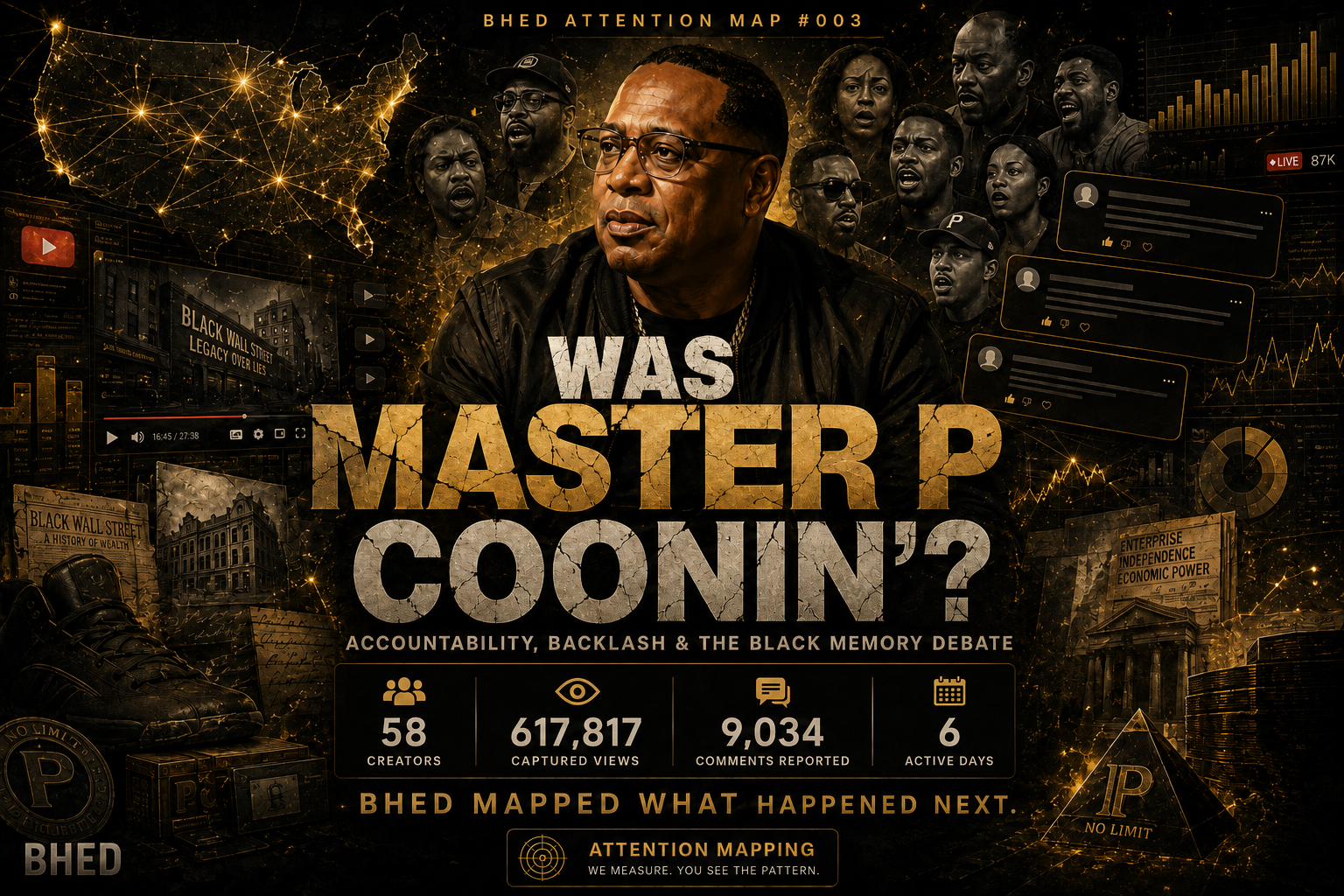
A stylized editorial portrait of Master P seated in reflective light, surrounded by gold-and-charcoal architectural textures symbolizing Black institution-building, historical memory, and public accountability.

What Happened

During a Forbes interview about business, ownership, Black products, and the racial wealth gap, Master P said he was trying to remove a "negative mindset" from the culture. He described Black people as continuing to return to slavery and asked, in substance, why they were still harping on it.

His statement was not delivered in isolation. In the surrounding conversation, he discussed Black Wall Street, supporting a Black-owned grocery store, producing goods for a broad market, creating more Black-owned companies, and closing the wealth gap. He also argued that integrity, good business, and relationships open doors.

That fuller context matters. It shows that Master P was attempting to preach agency, ownership, and economic action — not hostility toward Black people.

It does not erase the problem.

Master P was not asked whether Black people should forget slavery. He introduced slavery while explaining what he considers a negative cultural mindset. That move collapsed a historical and structural argument into a psychological deficiency. It treated continuing attention to slavery and its consequences as an obstacle to Black advancement, then offered extraordinary individual success as evidence that doors will open through integrity and good business.

Black people can build businesses and preserve historical memory at the same time. They can practice discipline while naming redlining, exclusion, stolen labor, discriminatory lending, destroyed communities, and the racial wealth gap.

Memory is not the opposite of movement.
Why It Matters to FBA

The question is not whether Master P has ever helped Black people. The question is what this particular public performance did.

In this instance, the remarks minimized legitimate attention to Black historical injury, shifted the explanation for unequal outcomes toward Black mentality, used exceptional success as if it were broadly available proof, and delivered a culturally reassuring message of individual responsibility while discussing commercial opportunity and Black consumer support.

BHED does not possess direct evidence that Master P privately intended to gain white approval or business access. We do not manufacture his motive. But public rhetoric has a function apart from private motive. Whatever he intended, the statement performed the familiar work of reassuring dominant interests that history and structure need not remain central to the analysis.

BHED Context

Master P's complete record cannot be reduced to one interview. His career is tied to independent Black enterprise, ownership, artist development, economic self-determination, and the effort to move Black products into wider markets. His current MoneYatti venture continues that ownership-centered message. His record gives the community legitimate reason to weigh this lapse with perspective rather than pretending that nothing positive came before it.

Accountability that erases a person's whole contribution is not historical analysis. It is disposal. Grace that refuses to name damaging conduct is not restoration. It is protection from consequences. Master P has earned grace. He has not earned immunity.

The proper correction is not for Master P to abandon his message about ownership, discipline, or action. It is for him to stop presenting historical memory and structural analysis as excuses standing between Black people and success. The stronger message would be: "We cannot change the past, but we must understand what the past built. We can confront those structures, preserve our history, and still build the future." That formulation demands agency without surrendering truth.

Master P engaged in cooning behavior in this instance. The evidence does not establish Master P as "a coon." His words deserve public discipline. His larger record deserves proportion, grace, and the opportunity for correction. He should be made an example of — but not thrown away.

Final doctrine: WE DO NOT PROTECT OUR GREATS FROM ACCOUNTABILITY. WE PROTECT ACCOUNTABILITY FROM BECOMING DISPOSAL.

What Is Established

  • Master P used "negative mindset," referenced slavery, and asked why people were still harping on it.
  • The surrounding interview included Black ownership, Tulsa, Oasis grocery store, broad-market products, and the wealth gap.
  • The rhetoric may function as commercial-acceptability signaling apart from private motive.
  • The conduct meets BHED's instance-level cooning-behavior standard.

Watch Next

Whether Master P revises the framing — and whether the community holds the line between accountability and disposal — is what we watch next.

Did a message about ownership cross into historical dismissal, or did it preach agency?

Return to Today’s Desk

THE COMMUNITY RESPONDED

What BHED members said after examining the record.

WAS MASTER P COONIN'?

Connected to: WAS MASTER P COONIN'?

This Pulse is closed. Results are preserved as a historical record.

Attention Map

Map #003

See how this story moved through the observable media field

You’ve read what happened. Now see how attention moved around it — who entered, where it concentrated, what audiences said, and how the conversation changed.

Explore the Attention Map